Skip to content
Prox-IA

How we operate

We start with your business, not with AI

Four stages, four deliverables. Understand: immersion in your real processes. Audit & document: The Baseline — mapping, process sheets, opportunity register, owned by the client. Improve: The Builds, each traced to a process sheet. Operate: The Engine Room, run and compliance kept alive under SLA.

The approach

Understand · Document · Improve · Prove

Each stage corresponds to a named offer — The Baseline, The Roadmap, The Builds, The Engine Room — with a clear deliverable and a decision at the end. You can stop at any stage: the file is yours.

  1. 01

    Understand

    Immersion in your business: interviews, observation of real processes — not the ones in the quality manual. We don’t talk about AI until we understand how your company actually works.

  2. 02

    Audit & document

    Mapping of priority processes, a sheet per process (volumes, time, systems, friction, regulatory constraints), an opportunity register showing where automation, ML or data pays off. The deliverable is yours.

  3. 03

    Improve

    Three families of builds — automation, data & forecasting, assistants & knowledge — each traced back to a process sheet from The Baseline. We don’t build anything that doesn’t serve a documented process.

  4. 04

    Operate & prove

    The Engine Room: run, supervision, updates, compliance kept alive. Your systems stay operated, documented and provable over time — not just on delivery day.

What our deliverables actually look like

No throwaway slideware: process documentation you can use without us. Here are three illustrative excerpts of what we actually deliver.

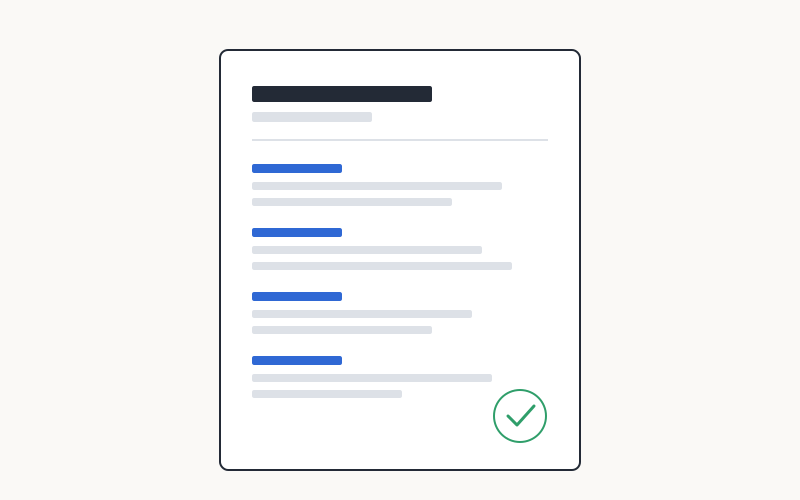
A process sheet from The Baseline

A process sheet from The Baseline

One sheet per audited process: volumes handled, time spent, systems touched, friction points, data produced and consumed, applicable regulatory constraints. A notation a human can read, not consulting-firm formalism.

  • Volumes, time and systems measured on the ground
  • Friction points identified and located
  • Data produced and consumed by the process
  • Applicable regulatory constraints, process by process

Illustrative excerpt — not a client document
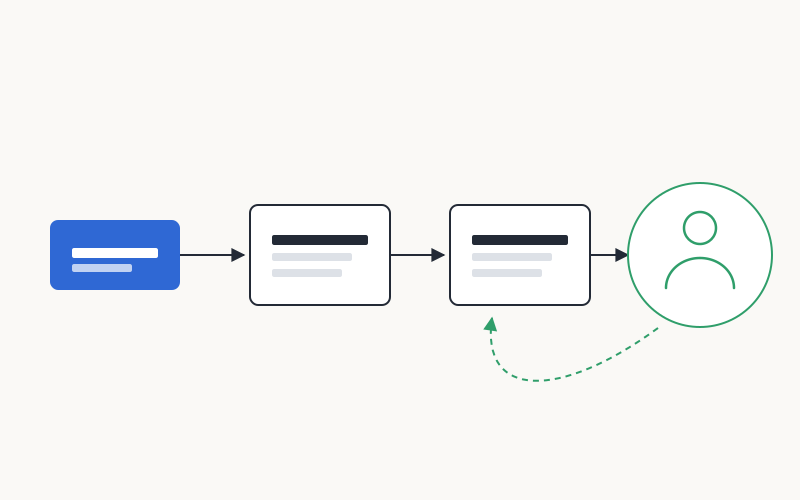
A typical process map: supplier invoices

A typical process map: supplier invoices

The full circuit of a supplier invoice — receipt, control, approval, posting, payment — with the systems touched, the handoff breaks and the automation opportunities noted. The most common typical build for SMEs.

  • End-to-end circuit, human-readable notation
  • Handoff breaks and re-keying identified
  • Automation opportunities with an honest effort/gain order of magnitude
  • Traceability: every proposed build references this map

Illustrative excerpt — not a client document
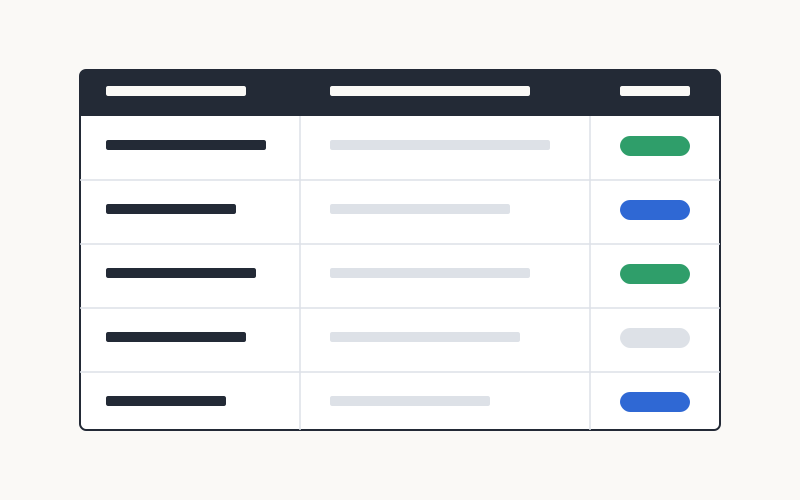
A typical AI Act register

A typical AI Act register

Every identified AI use case, classified by AI Act risk level, with the resulting obligations. Article 4 (AI literacy) has applied since 2 February 2025; high-risk obligations, since 2 August 2026. Classify before you build.

  • Inventory of AI use cases, existing and planned
  • Classification by AI Act risk level, from the outset
  • Applicable obligations per use case, dated
  • Direct feed into your GDPR record of processing activities (Article 30)

Illustrative excerpt — not a client document

Our principles

What never changes

We say no when it is warranted

"Don’t automate this" is a conclusion we deliver regularly, in writing. If The Baseline reveals nothing actionable, we tell you — our credibility is worth more than one more project.

Compliance from the start

AI Act classification from The Roadmap onward, not at the end of the project. Article 4 has applied since 2 February 2025, high-risk obligations since 2 August 2026: designing for compliance costs less than fixing it later.

Operable above all

We only deliver what can live in production and be maintained by someone other than its author. Documentation by construction, reversibility as the rule — verifiable in every contract.

Frequently asked questions

Before we start

How long does a Baseline take?
A few weeks, depending on the number of processes and systems involved. The scope is fixed before we start: a fixed-scope engagement, quote within 48 hours, never open-ended time and materials. The free Express Scan (90 minutes) lets you calibrate before committing.
Why don’t you publish prices?
Because a serious fixed-scope engagement depends on scope: the number of processes, systems, and regulatory requirements. Instead, written guarantees: quote within 48 hours, fixed-scope engagement — never open-ended time and materials —, no minimum-duration commitment on the way in, and a free Express Scan to calibrate.
Is the audit a disguised sales pitch?
No, and it’s contractual: the deliverable is yours and stays usable without Prox-IA. You can implement it alone or with another provider. And if The Baseline reveals nothing actionable, we tell you in writing.
Do you work with our teams or instead of them?
With them. The immersion happens on the ground, with the people who do the work. AI literacy and skills transfer are part of The Builds: we want you to stay autonomous — including from us.
What happened to the AI Express Diagnostic?
It became The Baseline: same starting point, enriched scope — process mapping, a sheet per process, an opportunity register, AI Act classification. The free way in is now called the Express Scan: 90 minutes and a one-pager summary.
What if you recommend doing nothing?
It happens, and we write it down in black and white. You keep process documentation that serves purposes beyond AI: onboarding, quality, knowledge transfer, audit preparation. An honest baseline assessment beats a useless build.

Start with a free Express Scan

90 minutes with a co-founder engineer, a one-pager summary. You’ll know whether a full Baseline is worth it — and if it isn’t, we’ll tell you.